
“The strongest network any child can ever have is not a mobile network or Wi-Fi connection, but the emotional support, understanding, time and unconditional presence of family.”

Dr. Ushavati Shetty
Mental Health Coach
Founder & Director
C4Cynerg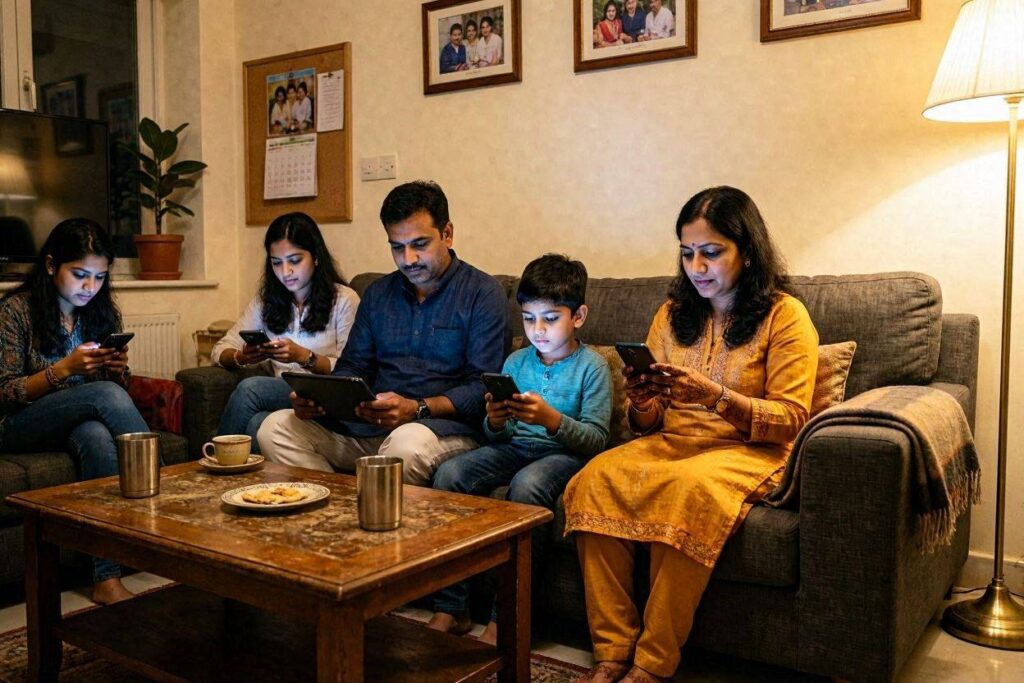
When a Convenience Becomes a Dependency
For the last twenty-five years, as a mental health coach and counsellor, I have had the privilege of interacting closely with students, teenagers, parents, principals, teachers, and families across different social and educational backgrounds. Over these years, I have witnessed remarkable transformations in education, parenting styles, career aspirations, and human relationships. However, among all the changes that society has undergone, one silent transformation has entered almost every home so deeply that many people no longer even recognise its psychological impact our unhealthy emotional dependence on mobile phones and digital devices.
What began as a technological convenience has now become an emotional necessity. Today, the mobile phone is no longer merely a communication tool. For many teenagers, it has become their identity, their social acceptance, their entertainment, their escape from loneliness, and sadly, even their emotional companion. We are no longer simply discussing “screen time.” We are discussing emotional detachment, psychological dependency, declining interpersonal skills, and the slow erosion of meaningful human connection.
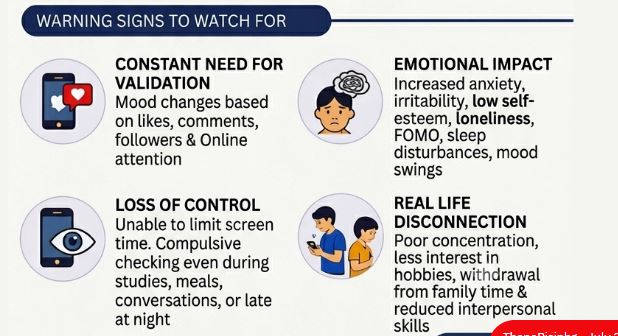
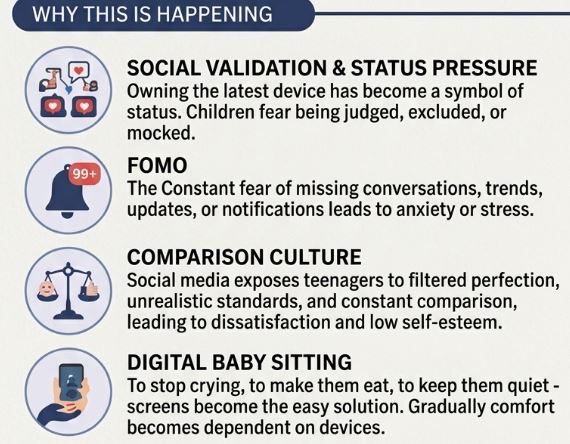
Technology today is evolving at an unimaginable pace. Before one device completes a year in the market, a newer version is already launched with upgraded features, better cameras, faster processors, advanced artificial intelligence, and stronger marketing campaigns. Every new launch silently creates pressure not only on adults, but especially on teenagers and young children who are growing up in a culture where self-worth is increasingly associated with possessions and appearances. Owning the “latest phone” has become a social status symbol. Children today are not merely asking for a device; they are asking for social acceptance, validation, and a feeling of belonging.
As a counsellor, I have observed countless teenagers feeling embarrassed because they do not own expensive gadgets like their peers. The pressure to “fit in” has become emotionally exhausting. A child carrying an older device often feels inferior in school or social circles. They fear being judged, excluded, or mocked. This constant comparison slowly damages self-esteem and creates emotional insecurity at a very young age.
The Pressure to Own the Latest Device
- social status
- fitting in
- comparison
- self-esteem
The Hidden Cost Parents Pay
However, behind this growing obsession with devices lies another reality that society often ignores the silent emotional and financial burden carried by parents. Technology comes at a cost, and it is certainly not inexpensive. Parents today are already balancing demanding careers, rising educational expenses, family responsibilities, social expectations, and economic pressures. Yet many feel compelled to fulfil their children’s demands for expensive phones, tablets, gaming systems, branded accessories, and constant digital upgrades simply to prevent them from “feeling left out.”
This creates tremendous parental stress. Many parents work longer hours, sacrifice personal comforts, compromise financial stability, or silently carry anxiety just to provide what society now labels as “normal.” Somewhere, the emotional pressure that begins with a mobile phone slowly enters the psychological environment of the entire household. Financial stress leads to emotional fatigue, emotional fatigue affects relationships, and strained relationships further increase emotional distance within families. The psychological impact of technology is therefore not limited to children alone it deeply affects parents, marriages, family dynamics, and emotional well-being across generations.
Social Media and the Comparison Trap
Teenagers today are growing up in a world where comparison never pauses. Every scroll exposes them to filtered perfection, luxurious lifestyles, unrealistic beauty standards, academic achievements, popularity, vacations, relationships, expensive gadgets, and carefully curated happiness. Social media rarely shows struggle, loneliness, rejection, insecurity, or failure. As a result, many young minds begin believing that everyone else is happier, more successful, more attractive, and more accepted than they are.
This constant comparison creates deep emotional dissatisfaction. Slowly, confidence begins to depend on likes, followers, comments, streaks, and online attention. A teenager’s mood today can change within seconds based on social media engagement. Their emotional stability is increasingly controlled by digital validation. Somewhere, individuality gets lost in the race to seek approval.
Understanding FOMO
One of the most dangerous psychological effects of excessive mobile dependency is the constant fear of missing out commonly known as FOMO. Teenagers today experience anxiety when disconnected from their phones, even briefly. They fear missing conversations, trends, updates, memes, notifications, or social interactions. Many students I have counselled openly admit that they sleep with their phones beside them and wake up multiple times during the night to check notifications. Mental rest has disappeared because the mind is constantly overstimulated.
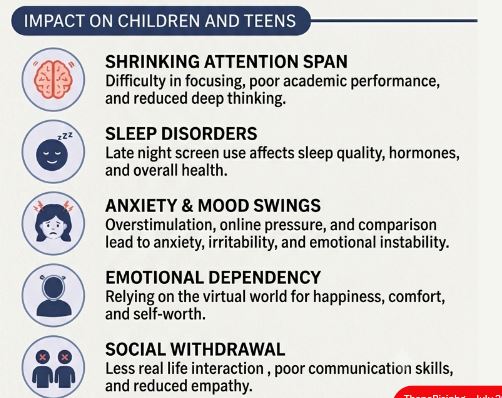
Several global studies have consistently highlighted the rise in anxiety, emotional instability, low self-confidence, sleep disorders, social withdrawal, poor concentration, irritability, and depressive symptoms linked to excessive screen exposure among adolescents. Many teenagers today struggle to sit quietly, focus deeply, or engage in meaningful conversations without the urge to check their devices. Attention spans are shrinking while emotional dependency is increasing.
Are Adults Setting the Example?
Yet, while we continue blaming children for mobile addiction, we must also ask ourselves an uncomfortable question : who introduced this dependency in the first place?
Children are not learning this behaviour in isolation. They are observing adults every single day. Parents complain about children being glued to screens, yet many homes today function in silence, with every family member absorbed in a separate device. In several households, both parents are occupied with demanding professional lives and hectic schedules. Children are often left under the care of grandparents or elderly caregivers. Sadly, even the older generation today is becoming increasingly attached to mobile phones, forwarded videos, television content, online shopping, and endless digital consumption.
Earlier, grandparents passed down stories, values, emotional warmth, traditions, and conversations. Today, in many homes, even the elderly are emotionally occupied by screens. The result is heartbreaking, three generations may be living under one roof, yet emotional interaction is steadily disappearing.
The Mobile Phone as a Digital Babysitter
One of the most concerning realities I have personally observed is how early children are being introduced to screens. A toddler cries and a mobile phone is handed over. A child refuses to eat and cartoons are switched on. A child becomes restless in public and the device becomes the distraction. Gradually, the child’s brain begins associating comfort, entertainment, emotional regulation, and silence with screens. The mobile phone slowly transforms into a digital babysitter.
Then, years later, when the same child becomes addicted to gaming, social media, or digital stimulation, society suddenly questions what went wrong. But the truth is simple and uncomfortable somewhere, as a generation, we ourselves normalised digital dependency.
Why Mobile Addiction Is Really an Emotional Issue
Mobile addiction is not merely a behavioural issue; it is deeply psychological. Many teenagers use their phones not because they are irresponsible, but because they are emotionally overwhelmed. The digital world becomes an escape from loneliness, academic stress, peer pressure, emotional neglect, boredom, rejection, or lack of confidence. The virtual world feels easier because it demands less emotional vulnerability than real-life interactions.
Unfortunately, true personality development cannot happen behind screens alone. Personality develops through experiences, communication, emotional expression, failures, teamwork, public speaking, outdoor play, creativity, empathy, friendships, and real human interactions. A child may appear socially active online yet feel emotionally disconnected internally. We are raising a generation that is digitally connected but emotionally isolated.
Today, families often speak about the “generation gap.” But perhaps the real gap is not between generations. The real gap is the emotional distance silently growing between people who live in the same home yet rarely communicate meaningfully. Earlier, homes echoed with laughter, discussions, storytelling, shared meals, and emotional bonding. Today, many families sit together physically while emotionally living in different digital worlds.
Rebuilding Human Connection
The solution is not complete restriction or punishment. Teenagers today do not need constant criticism; they need guidance, emotional security, and healthy role models. Parents must consciously create environments where conversations are encouraged, family time is protected, and emotional presence becomes a priority. Simple practices such as device-free meals, family outings, reading habits, sports, hobbies, travelling together, creative activities, and meaningful discussions can rebuild emotional connection within homes.
Children must be encouraged to experience life beyond screens to participate in sports, music, theatre, volunteering, debates, art, outdoor activities, and social interactions that strengthen confidence and emotional intelligence. Schools too must actively prioritise mental health awareness, counselling support, personality development, and digital wellness education. Teaching children how to disconnect is now equally important as teaching them how to connect.
As someone who has spent decades working closely with young minds and families, I genuinely believe that today’s generation is not weak. They are growing up in an era of constant stimulation, endless comparison, relentless competition, and overwhelming digital exposure. What they need is not judgement, but understanding. Not control, but connection. Not emotional absence, but involvement.
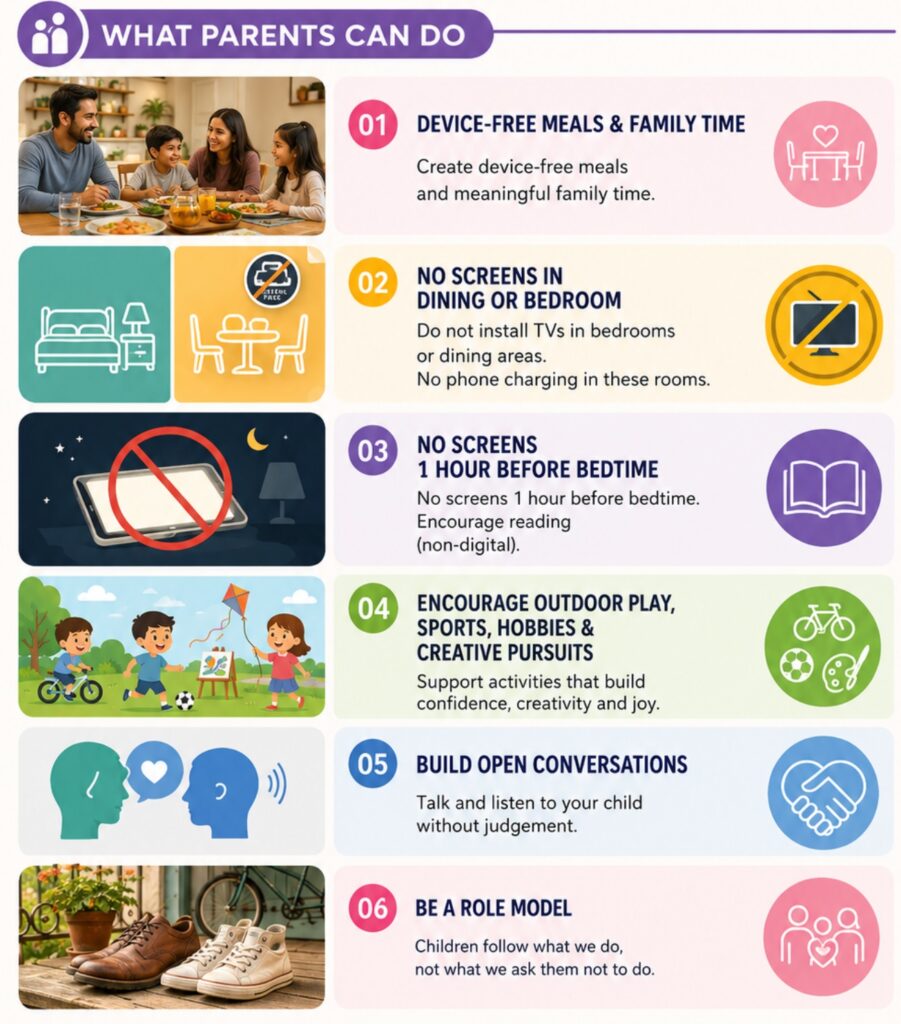
If we truly wish to reduce mobile addiction among children and teenagers, we must first reflect upon our own habits as adults. Children may not always follow our instructions, but they unquestionably absorb our behaviour. A home where conversations are valued more than screens, where emotional bonding is stronger than internet connectivity, and where people genuinely listen to one another automatically creates emotionally healthier children.
At the end of the day, the issue is not simply about mobile phones. It is about preserving humanity in a world increasingly dominated by screens. Technology should remain a part of life, not become the centre of life itself. Because no device, no application, no notification, and no virtual interaction can ever replace the warmth of human presence, emotional security, genuine relationships, and meaningful connection.
Technology Should Remain a Part of Life, Not the Centre of Life
The future of our children will not be determined only by how technologically advanced they become, but by how emotionally balanced, mentally resilient, and socially connected they remain. If we truly wish to raise confident, compassionate, emotionally secure, and mentally healthy individuals, then we must teach our children not only when to connect online, but also when to disconnect and reconnect with real life. The strongest network any child can ever have is not a mobile network or Wi-Fi connection but it is the emotional support, understanding, time, and unconditional presence of family.
Originally published in ThaneRising Magazine – Issue 01